Forecast - 2026.04.11 - Final update before the election
Tomorrow is election day. This is the final update from our Krónikás-v3 model before the 2026 Hungarian parliamentary election. Based on 40,000 Monte Carlo simulations, TISZA’s probability of winning an outright majority has risen to 86.7%, up from 79.7% a week ago. The model shifted in TISZA’s favour in the final week of the campaign.
What is this forecast? (If you are reading for the first time)
SzázKilencvenKilenc is a data-driven, nonpartisan election forecast. The **Krónikás-v3** model filters out the partisan biases embedded in individual polls (so-called house effects), then runs 40,000 simulations of possible election outcomes. The result is not a single number but a **set of probabilities**: it shows how many of the 40,000 scenarios produce a majority for each party. This is analogous to a weather forecast: if we say there is an "80% chance of rain", that does not mean it will definitely rain -- it means that given the current conditions, rain is the most likely outcome. If it stays dry, the forecast was not wrong -- the 20% scenario can happen too.Election day forecast
Vote share
The model’s expected vote shares on election day:
| Party | Expected vote share |
|---|---|
| TISZA | 48.5% |
| Fidesz-KDNP | 40.8% |
| Mi Hazánk | 5.7% |
| MKKP | 2.5% |
| DK | 2.3% |
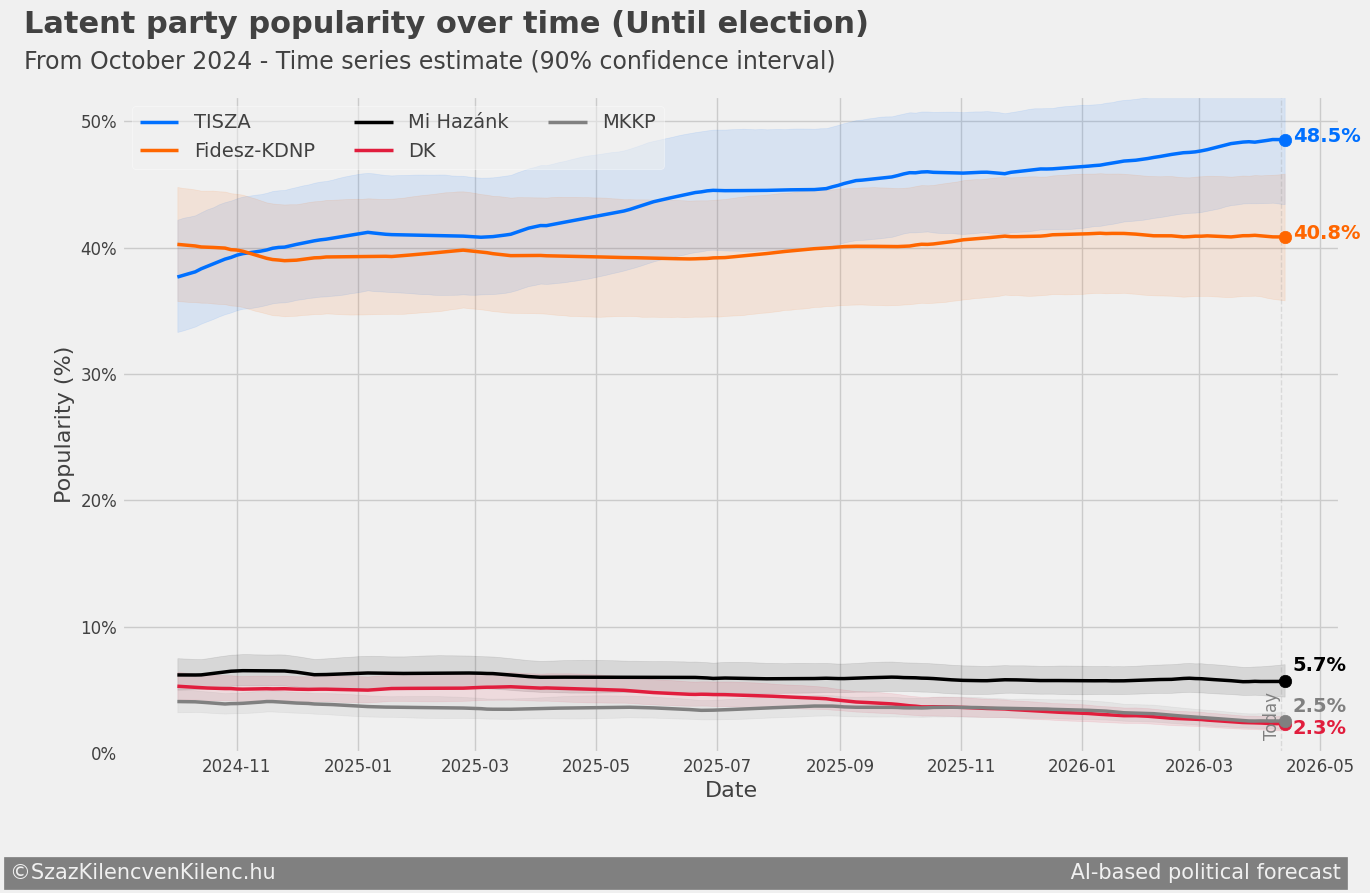
TISZA leads by 7.7 percentage points in the simulation average.
Seats
The table below shows the expected average seat counts across all simulations. In this update, the nationality seat is listed separately (in previous forecasts it was included in the Fidesz-KDNP total, as the government-aligned candidate won it in 2022).
| Party | Average seats | Rounded |
|---|---|---|
| TISZA | 118.2 | 118 |
| Fidesz-KDNP | 75.1 | 75 |
| Mi Hazánk | 4.7 | 5 |
| Nationality seat | 1 | 1 |
| DK | 0.0 | 0 |
| MKKP | 0.0 | 0 |
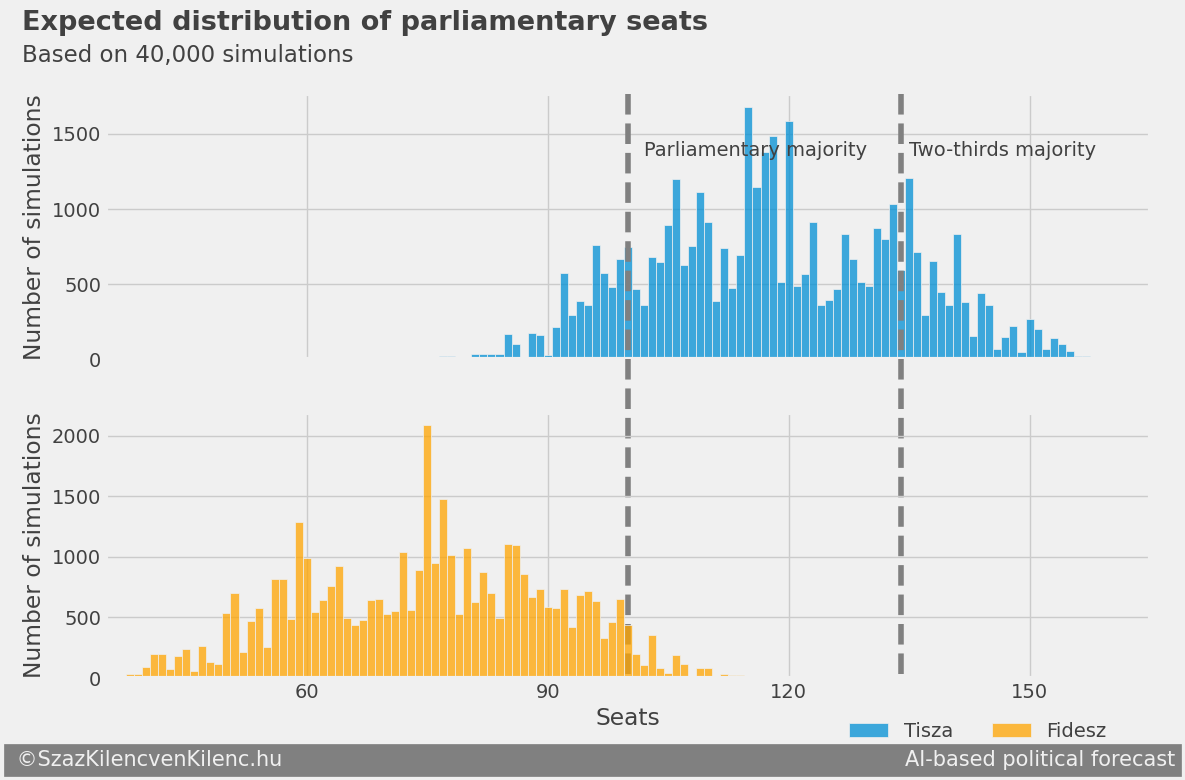
TISZA’s average seat count of 118.2 (rounded: 118) holds firmly above the 100-seat majority threshold. Fidesz-KDNP averages 75.1 (rounded: 75), excluding the nationality seat.
Outcome probabilities
| Outcome | Probability |
|---|---|
| TISZA majority (100+ seats) | 86.7% |
| Fidesz-KDNP majority (100+ seats) | 6.7% |
| Deadlock (neither reaches 100) | 6.7% |
| TISZA two-thirds majority (133+) | 22.5% |
| Fidesz-KDNP two-thirds majority (133+) | 0.0% |
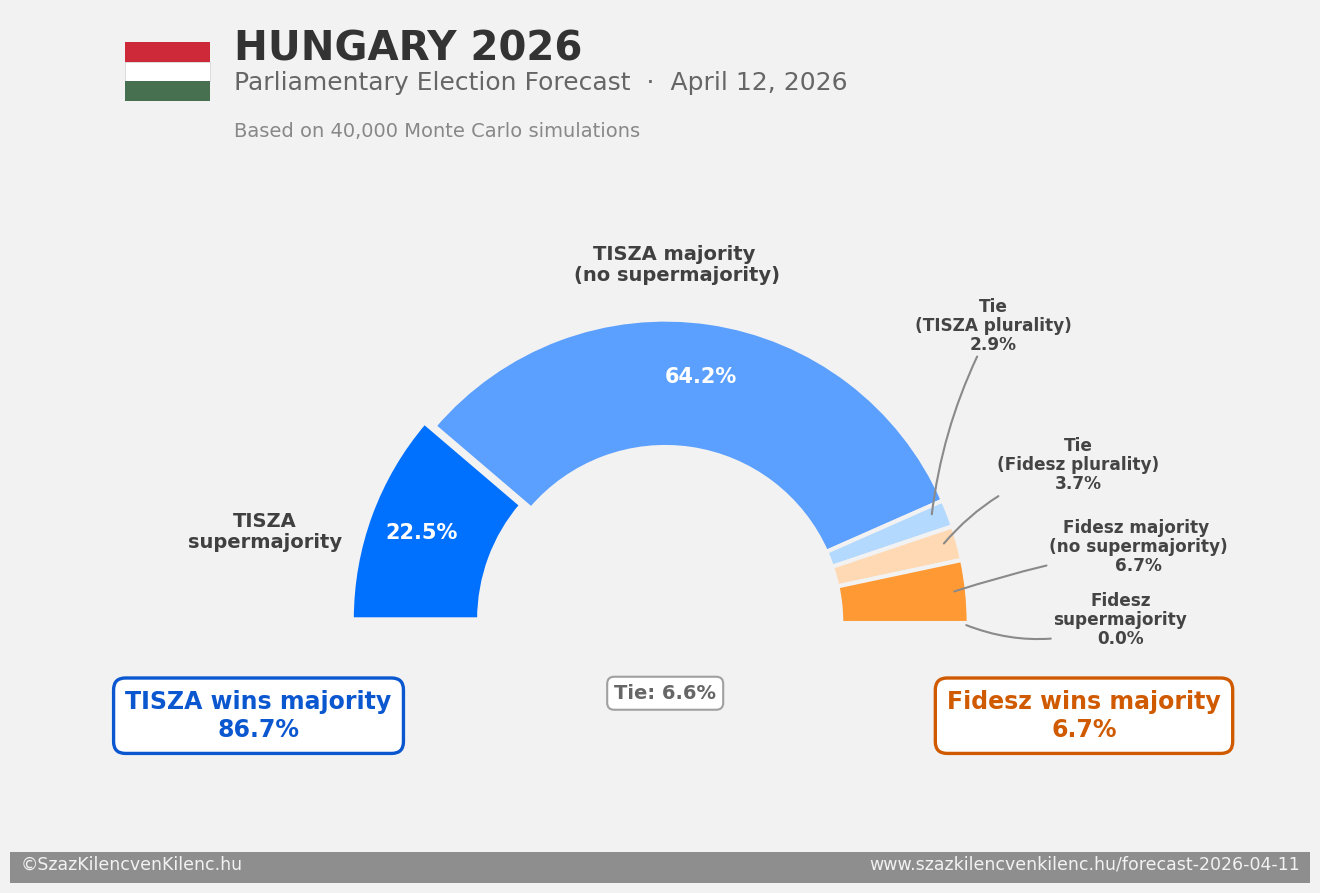
What does an 86.7% TISZA majority probability actually mean? It means that in roughly 34,680 of the 40,000 simulations, TISZA crosses the 100-seat threshold and can form a government alone. In the remaining roughly 13%, either Fidesz-KDNP wins the majority (6.7%), or neither party reaches 100 seats (6.7%).
TISZA’s two-thirds probability has jumped to 22.5%, up from 11.4% last week. This means roughly one in four to five simulations now produces a TISZA supermajority. To put this in context: TISZA’s probability of a two-thirds majority (22.5%) is now higher than Fidesz-KDNP’s probability of winning any majority at all (6.7%). That said, a two-thirds outcome is still not the most likely scenario.
Small parties: Mi Hazánk above the threshold
| Party | Probability of entry | Expected vote share |
|---|---|---|
| Mi Hazánk | 72.1% | 5.7% |
| DK | 0.0% | 2.3% |
| MKKP | 0.0% | 2.5% |
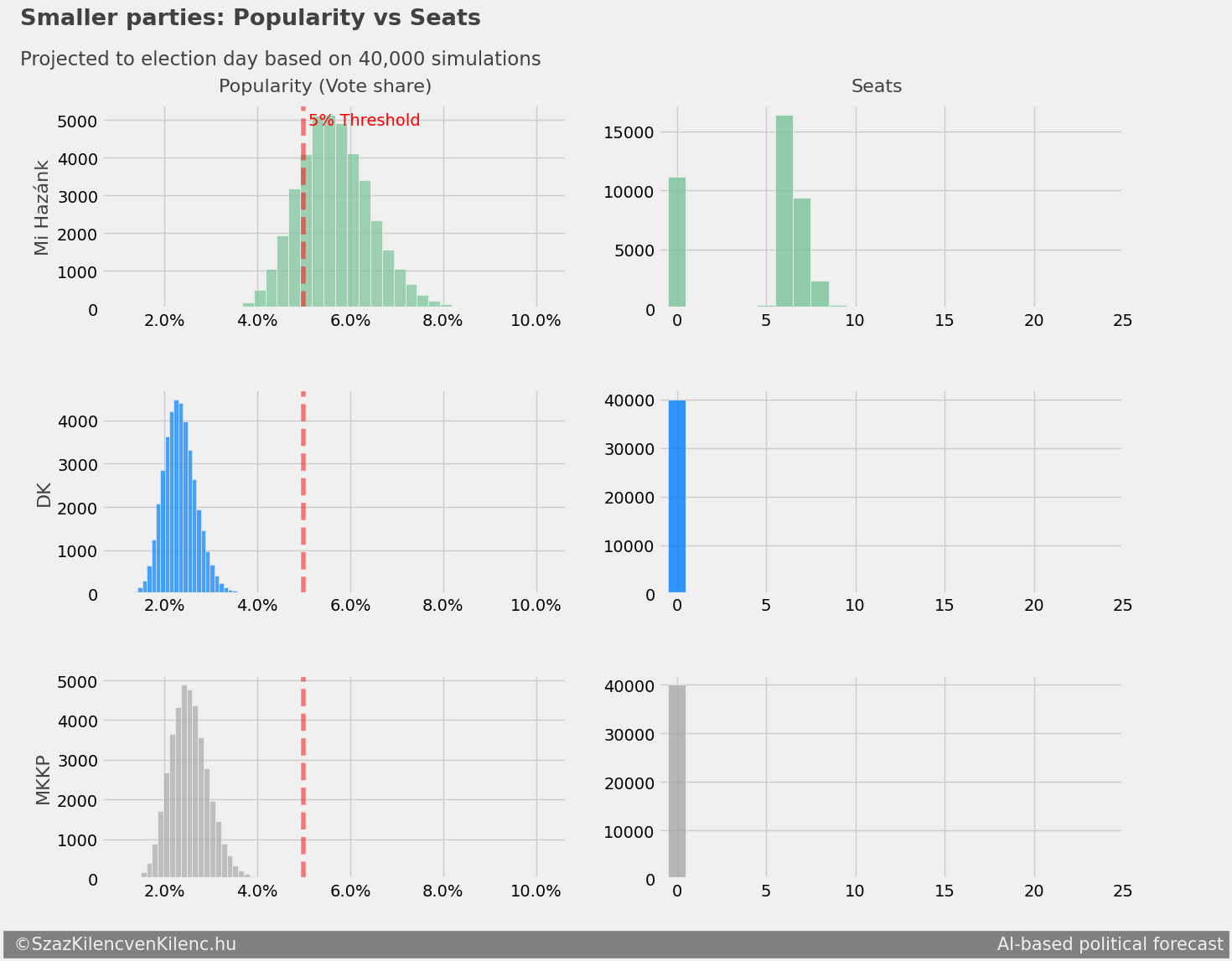
Mi Hazánk’s probability of entering parliament has risen to 72.1%, up from 62.5% last week. This is the most significant change of the final week. The party’s average vote share has stabilised above the 5% threshold, but uncertainty remains high: in roughly seven out of ten simulations the party clears it, and in three it does not.
Mi Hazánk’s entry remains a key factor for the final outcome. If they enter parliament, seats are split three ways, increasing the probability of a deadlock. If they do not, most of their seats are redistributed to Fidesz-KDNP through individual constituencies.
DK and MKKP remain below the entry threshold.
Coalition scenarios
| Coalition | Majority (100+) | Two-thirds (133+) |
|---|---|---|
| TISZA alone | 86.7% | 22.5% |
| TISZA + Mi Hazánk | 93.3% | 30.7% |
| Fidesz-KDNP alone | 6.7% | 0.0% |
| Fidesz + Mi Hazánk | 13.3% | 0.0% |
What has changed since the previous forecast?
| Indicator | Apr. 3 | Apr. 11 | Change |
|---|---|---|---|
| Probability of TISZA majority | 79.7% | 86.7% | 📈 +7.0pp |
| Probability of Fidesz majority | 11.8% | 6.7% | 📉 -5.1pp |
| Probability of deadlock | 8.5% | 6.7% | 📉 -1.8pp |
| Probability of TISZA two-thirds | 11.4% | 22.5% | 📈 +11.1pp |
| Mi Hazánk entry probability | 62.5% | 72.1% | 📈 +9.6pp |
| TISZA vote share (mean) | 47.4% | 48.5% | 📈 +1.1pp |
| Fidesz vote share (mean) | 42.0% | 40.8% | 📉 -1.2pp |
| TISZA average seats | 112.7 | 118.2 | 📈 +5.5 |
In contrast to the stability of recent weeks, the final week brought meaningful movement. TISZA’s lead widened, Fidesz-KDNP’s majority probability dropped to nearly half, and TISZA’s two-thirds probability doubled. Mi Hazánk’s entry probability also rose significantly.
One day before the election: the bottom line
The four numbers that matter most today:
- 86.7% – TISZA’s probability of an outright majority
- 6.7% – Fidesz-KDNP’s probability of an outright majority
- 72.1% – Mi Hazánk’s probability of entering parliament
- 22.5% – TISZA’s probability of a two-thirds majority
The model shifted in TISZA’s favour in the final week. The lead widened, and this is reflected in the seat estimates. But it is important to remember: a 6.7% Fidesz probability is not zero. When you roll a die, a six can come up (at least on 15 sided dice). The chance of TISZA getting a two-thirds majority is higher than Fidesz-KDNP getting any majority at all. Tomorrow we find out.
A note on the nationality seat: One of the 199 seats in Hungary’s parliament is allocated to the nationality list. In previous forecasts we included this in the Fidesz-KDNP total. In this update we list it separately for clarity.
Important note: These results are forecasts based on 40,000 Monte Carlo simulations. Actual results may differ from the forecast.
This forecast is based solely on statistical models and does not constitute a political position.
The polling data come from the Vox Populi database, for whose work I hereby express my thanks.