Forecast - 2026.03.28
There are barely two weeks left until the 2026 parliamentary election. According to our latest Krónikás-v3 model, based on 40,000 Monte Carlo simulations, TISZA’s lead has grown further: the party’s majority probability has risen from 70.8% to 79.7%, while Mi Hazánk has weakened significantly, its probability of entering parliament falling from 81.6% to 61.0%. As a direct consequence, the probability of a deadlock has also dropped: from 13.7% to 7.9%. Entering the final phase of the campaign, TISZA’s position is clearly stronger than it was two weeks ago.
Current popularity
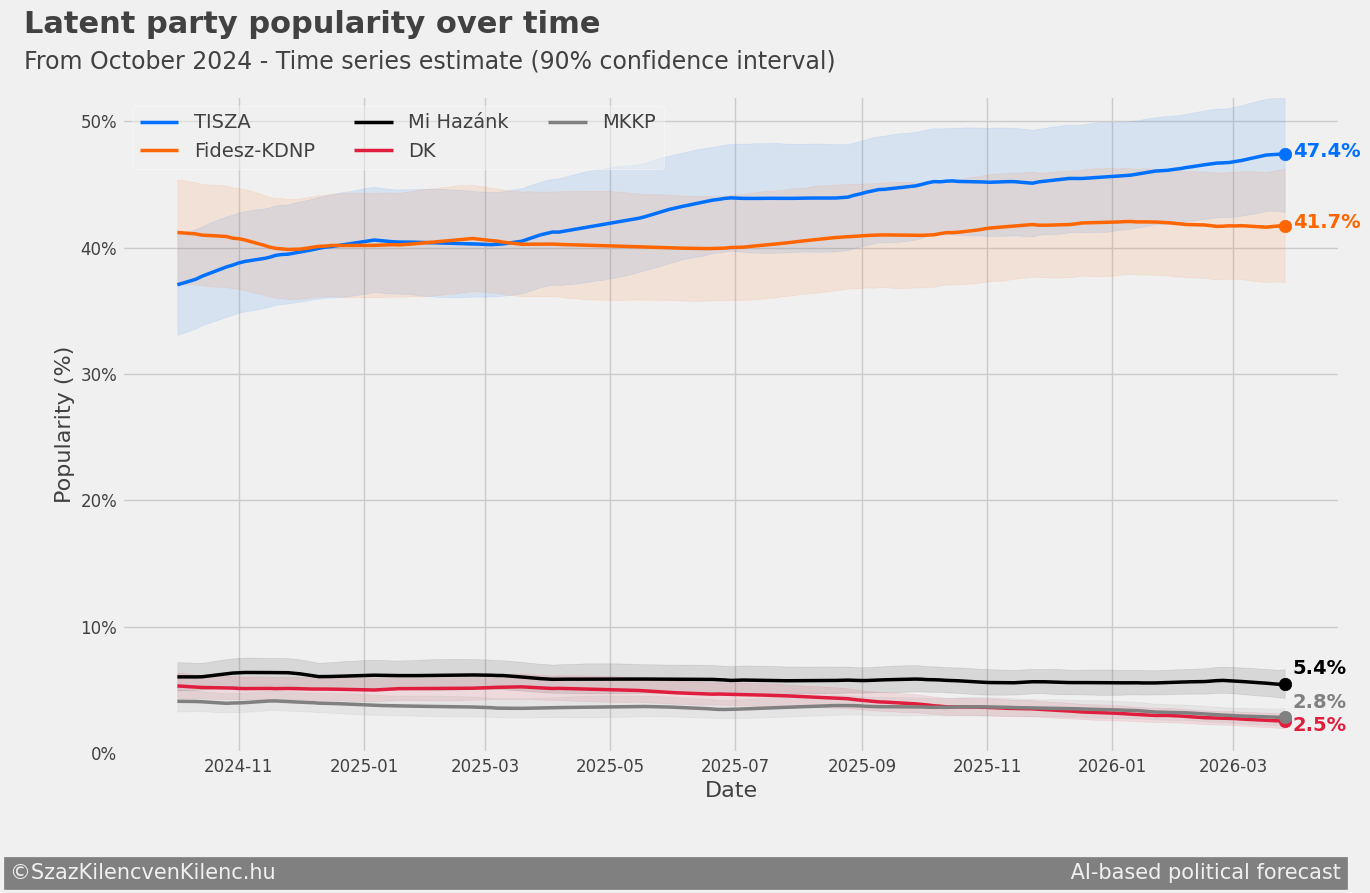
According to the latest estimate of our Bayesian time-series model, TISZA’s lead has grown, while Mi Hazánk has fallen back.
| Party | Popularity |
|---|---|
| TISZA | 47.4% |
| Fidesz-KDNP | 41.7% |
| Mi Hazánk | 5.4% |
| MKKP | 2.8% |
| DK | 2.5% |
TISZA leads by 5.7 percentage points — the largest gap between the two parties so far. The spread has widened from the 4.5-point margin recorded on March 21. With two weeks until the election, this lead is extremely difficult to reverse: the model’s uncertainty band has continued to narrow, and TISZA’s lead is well beyond the typical margin of polling error.
Election day forecast: a strengthening TISZA advantage
Vote share
Our election day forecast shows an even clearer TISZA advantage than before:
| Fidesz-KDNP | TISZA | |
|---|---|---|
| Receives the most votes | 17.0% | 83.0% |
| Wins the most seats | 16.7% | 83.3% |
In more than four out of five simulations, TISZA receives the most votes and wins the most seats. The probability of TISZA receiving the most votes has risen from 76.7% on March 21 to 83.0%.
Seat distribution
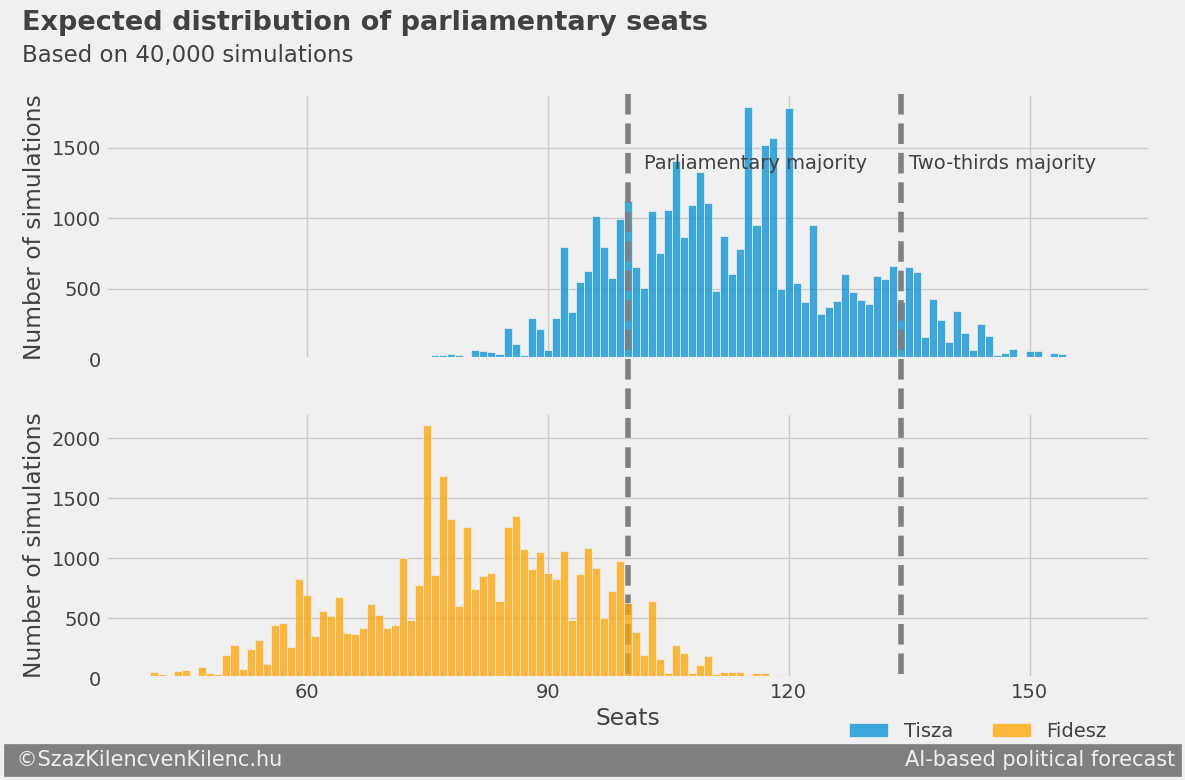
Based on the simulations, TISZA would receive an average of 113.4 seats — an improvement of nearly 4 seats compared to the 109.6 recorded two weeks ago, and holding firmly above the 100-seat majority threshold. The width of the distribution has continued to narrow as the election approaches, though surprises at the tails remain possible.
Outcome probabilities
| Outcome | Probability |
|---|---|
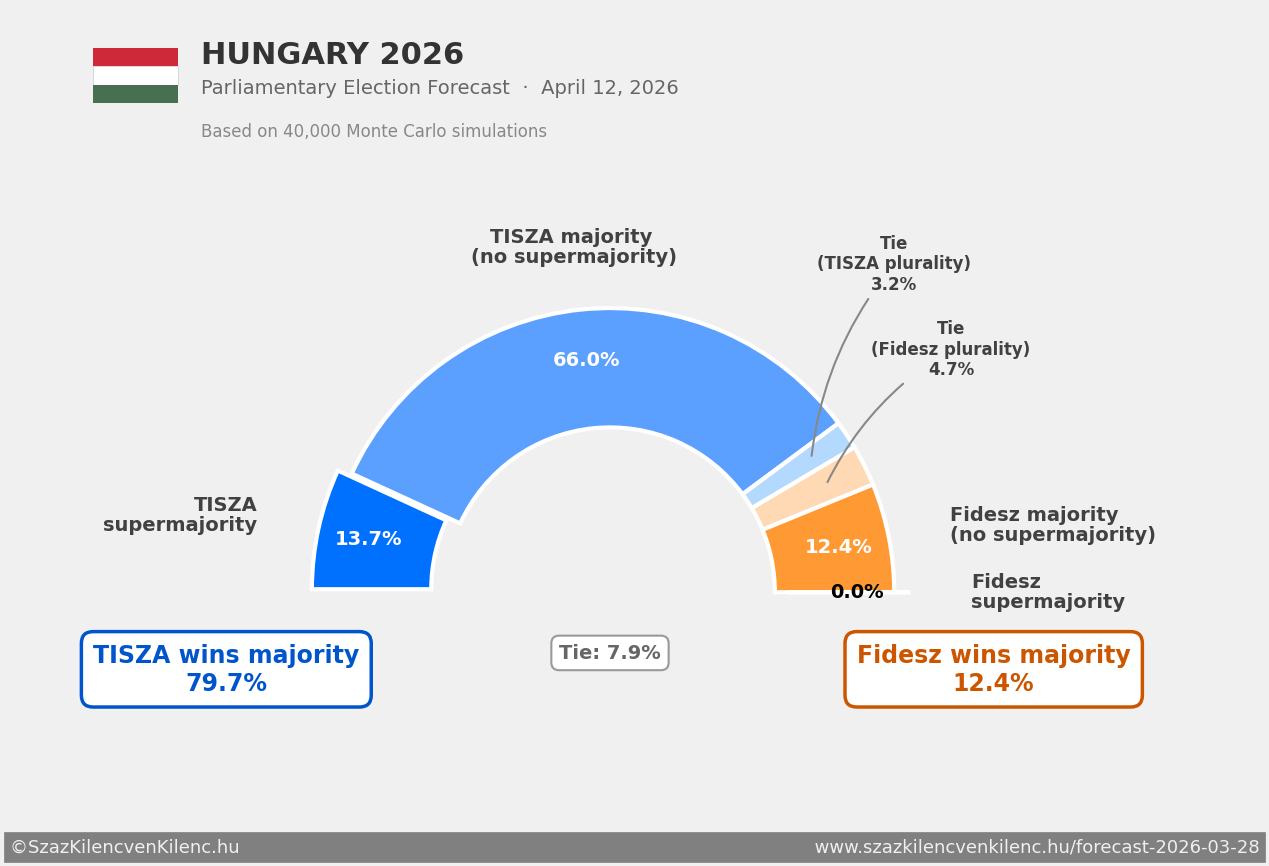
| TISZA majority (≥100 seats) | 79.7% |
| Fidesz-KDNP majority (≥100 seats) | 12.4% |
| 🔴 DEADLOCK (neither reaches 100) | 7.9% |
| TISZA two-thirds majority (≥133) | 13.8% |
| Fidesz-KDNP two-thirds majority (≥133) | 0.0% |
The big picture has shifted clearly in TISZA’s direction compared to the March 21 forecast: TISZA’s majority probability has jumped by nearly 9 percentage points (70.8% → 79.7%), while Fidesz-KDNP’s probability of an outright majority has fallen further (15.6% → 12.4%). TISZA’s two-thirds probability has also risen: from 10.0% to 13.8% — meaning roughly one in seven simulations now produces a TISZA supermajority.
What is driving the change?
The most important factor is Mi Hazánk’s decline. The party’s probability of entering parliament has dropped from 81.6% to 61.0%. If that happens, the vast majority of seats are divided between the two major parties, and TISZA’s vote share advantage translates more directly into a seat advantage.
In our March 21 analysis, we reported precisely the opposite trend: Mi Hazánk’s strengthening was increasing the probability of a deadlock. We are now seeing that trend reversed — and this strengthens TISZA’s position.
Probability of a deadlock: 7.9%
The probability that neither party reaches 100 seats on its own has fallen from 13.7% on March 21 to 7.9% — nearly halving. The reason is straightforward: if Mi Hazánk does not enter parliament (currently a 39% probability), seats are effectively split two ways, and TISZA’s vote share lead is sufficient for an outright majority.
Coalition scenarios
With Mi Hazánk’s weakening, coalition arithmetic has simplified:
| Coalition | Majority (≥100) | Two-thirds (≥133) |
|---|---|---|
| Fidesz-KDNP alone | 12.4% | 0.0% |
| Fidesz + Mi Hazánk | 20.2% | 0.0% |
| TISZA alone | 79.7% | 13.8% |
| TISZA + Mi Hazánk | 87.6% | 18.9% |
A Fidesz + Mi Hazánk coalition now has a 20.2% chance of securing a majority — down from 29.2% on March 21, and now less than half of the 49.4% recorded in early February. With Mi Hazánk’s decline, this coalition scenario is becoming increasingly irrelevant.
TISZA’s standalone majority at 79.7% indicates that governing without coalition pressure is by far the most likely outcome.
The probability of DK and MKKP entering parliament is effectively zero (both 0.0%).
Small parties: Mi Hazánk’s trend has reversed
| Party | Probability of entry | Expected vote share |
|---|---|---|
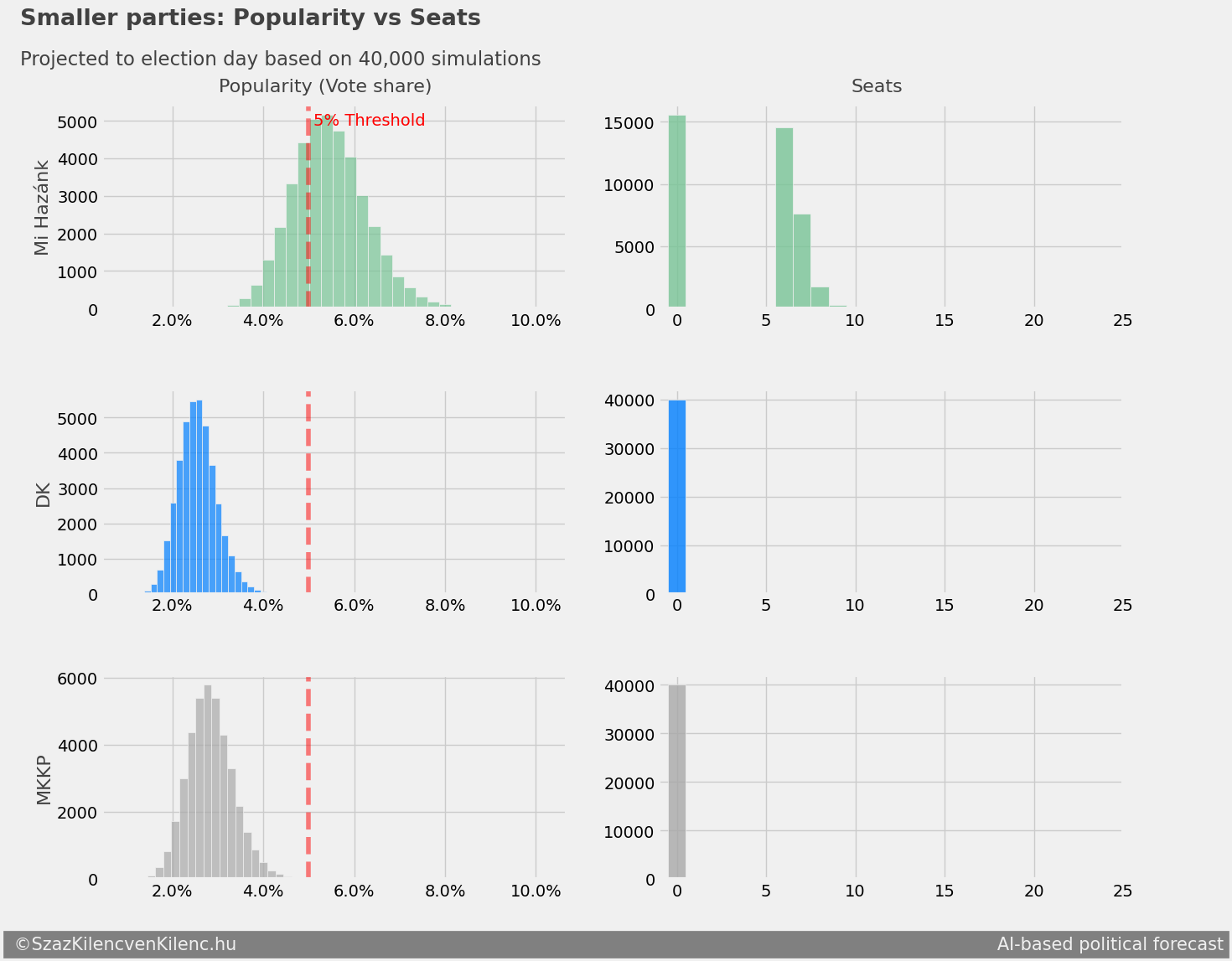
| Mi Hazánk | 61.0% | 5.5% |
| DK | 0.0% | 2.5% |
| MKKP | 0.0% | 2.8% |
Mi Hazánk’s probability of entering parliament has fallen from 81.6% on March 21 to 61.0% — the party’s average vote share has also dropped from 6.1% to 5.5%. This is the most significant shift of the week. In the previous two updates, Mi Hazánk had been steadily strengthening (72.8% → 81.6%); that trend has now reversed. The party still clears the threshold in the majority of simulations, but its position is far less secure than it was a week ago.
DK and MKKP remain below the entry threshold with no realistic chance of entering parliament.
What has changed (and what hasn’t) since the previous forecast?
Our March 21 forecast was also built on the Krónikás-v3 model. The most important takeaway from this update: TISZA has strengthened further, and Mi Hazánk’s decline has reshaped the probability map.
| Indicator | Mar. 21 (v3) | Mar. 28 (v3) | Change |
|---|---|---|---|
| Probability of deadlock | 13.7% | 7.9% | 📉 -5.8pp |
| Probability of TISZA majority | 70.8% | 79.7% | 📈 +8.9pp |
| Probability of Fidesz majority | 15.6% | 12.4% | 📉 -3.2pp |
| Probability of TISZA two-thirds | 10.0% | 13.8% | 📈 +3.8pp |
| Mi Hazánk entry probability | 81.6% | 61.0% | 📉 -20.6pp |
| TISZA vote share (mean) | 46.2% | 47.4% | 📈 +1.2pp |
| Fidesz vote share (mean) | 41.7% | 41.7% | — |
The magnitude of the shift is the largest we have recorded in a single update. TISZA’s majority probability jumped by nearly 9 percentage points, driven by two factors: TISZA’s own popularity has grown (47.4%), and Mi Hazánk’s decline has reduced the probability of a three-party parliament.
Two weeks out: the bottom line
The three numbers that matter most today:
- 79.7% — TISZA’s probability of an outright majority
- 12.4% — Fidesz-KDNP’s probability of an outright majority
- 61.0% — Mi Hazánk’s probability of entering parliament
The picture has shifted in TISZA’s favour. The party’s lead has grown, Mi Hazánk has fallen back, and the probability of a deadlock has halved. Fidesz-KDNP’s popularity has remained unchanged: Fidesz has not weakened, but the other movements have strengthened TISZA’s position.
For Fidesz-KDNP to reverse the current situation, clawing back a few percentage points in the final weeks of the campaign would not be enough: according to the simulations, TISZA’s lead is large enough that only an extraordinary shift could produce a different outcome. That is not impossible, but according to the model, it is becoming increasingly unlikely.
Important note: Current popularity figures reflect the present situation. Election day results are forecasts calculated from 40,000 Monte Carlo simulations. Actual results may differ from the forecast.
This forecast is based solely on statistical models and does not constitute a political position.
The polling data come from the Vox Populi database, for whose work I hereby express my thanks.