Forecast - 2026.03.21
There are barely three weeks left until the 2026 parliamentary election. According to our latest Krónikás-v3 model, based on 40,000 Monte Carlo simulations, TISZA’s lead remains stable, Fidesz-KDNP has not managed to close the gap, and the most important development is Mi Hazánk’s continued strengthening: its probability of entering parliament has risen from 72.8% to 81.6%, which has also increased the probability of a deadlock. The big picture has not changed — but three-player parliamentary arithmetic is becoming increasingly likely.
Current popularity
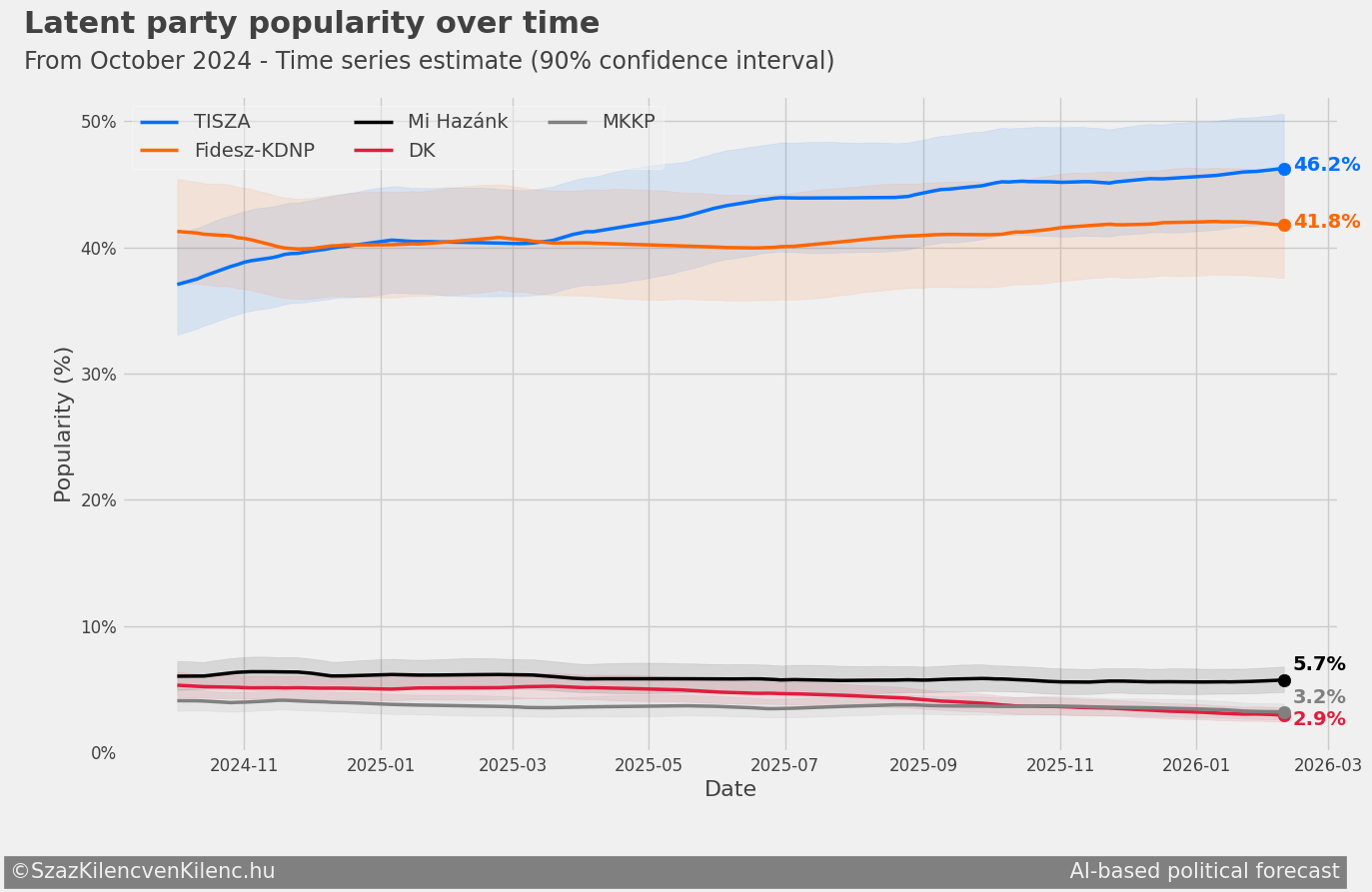
According to the latest estimate of our Bayesian time-series model, the gap between TISZA and Fidesz-KDNP remains essentially unchanged, while Mi Hazánk has continued to strengthen.
| Party | Popularity |
|---|---|
| TISZA | 46.2% |
| Fidesz-KDNP | 41.7% |
| Mi Hazánk | 6.0% |
| MKKP | 3.0% |
| DK | 2.9% |
TISZA leads by 4.5 percentage points — effectively identical to our measurement two weeks ago. The important context here: as the election approaches, a lead of this magnitude becomes increasingly difficult to reverse. The less time remains, the less room there is for movement — and TISZA’s current lead is well beyond the typical margin of polling error.
Election day forecast: Stable TISZA advantage
Vote share
Our election day forecast continues to show a clear TISZA advantage:
| Fidesz-KDNP | TISZA | |
|---|---|---|
| Receives the most votes | 23.3% | 76.7% |
| Wins the most seats | 23.1% | 76.9% |
In three out of four simulations, TISZA receives the most votes and seats. This is no longer a coin toss — it is more like rolling three dice and needing all sixes for a Fidesz win.
Seat distribution
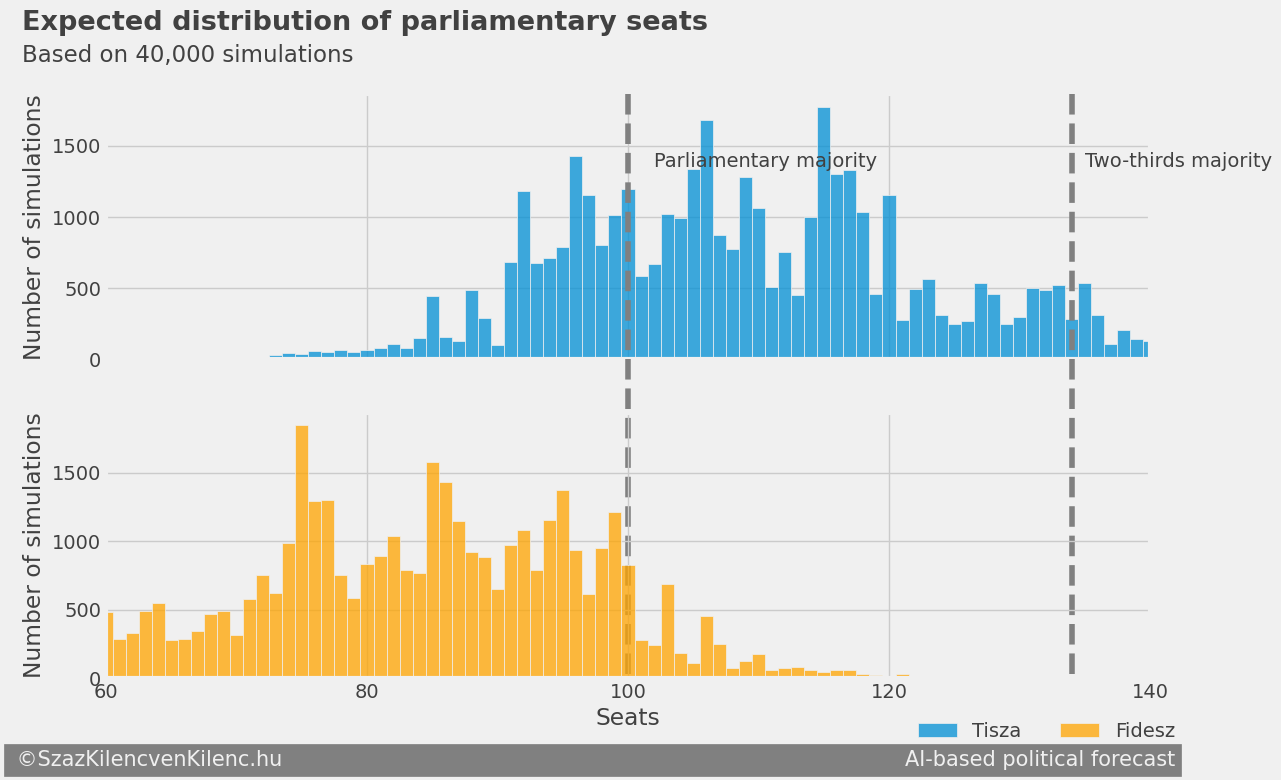
Based on the simulations, TISZA would receive an average of 109.6 seats — holding steadily above the 100-seat majority threshold. That said, the width of the distribution remains significant: the simulation does not produce a single number but a probability range, and anything can happen at the tails.
Outcome probabilities
| Outcome | Probability |
|---|---|
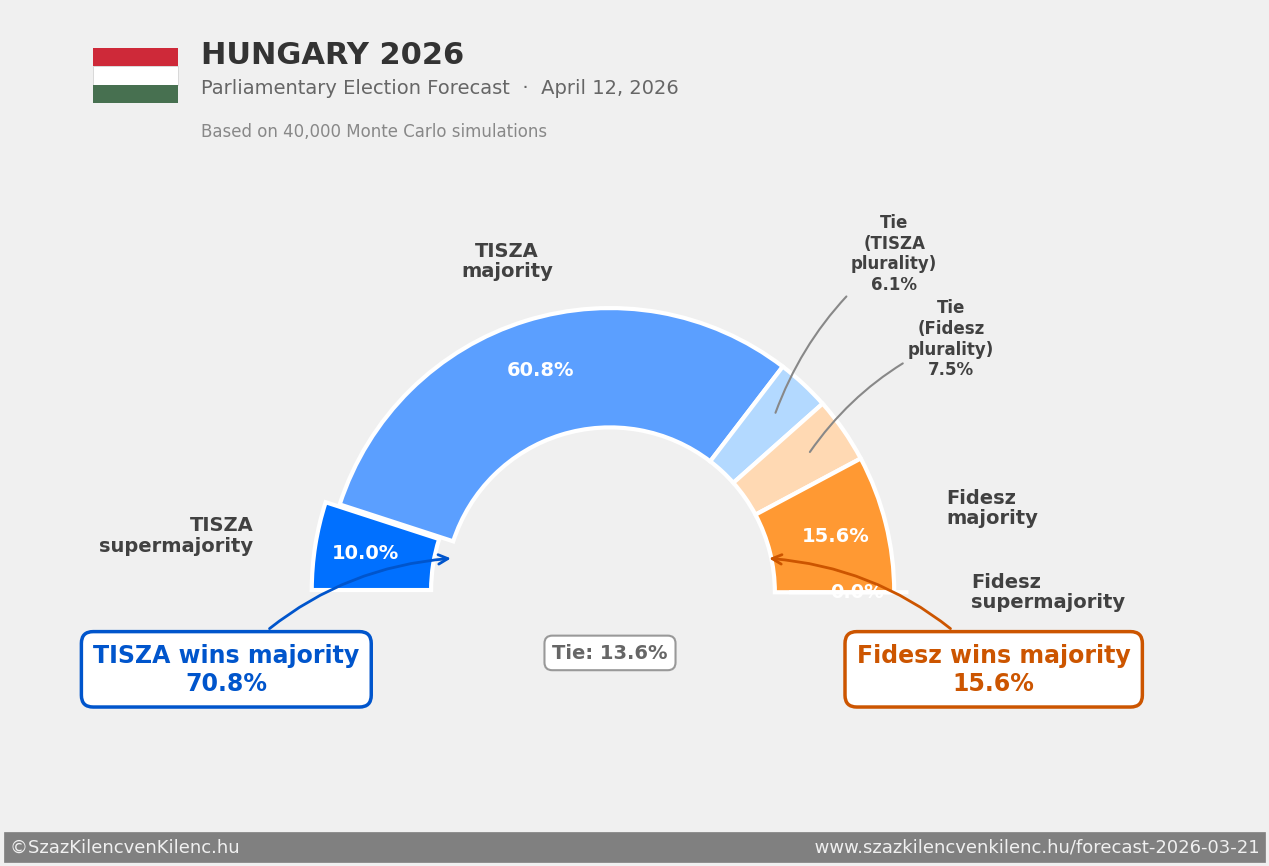
| TISZA majority (≥100 seats) | 70.8% |
| Fidesz-KDNP majority (≥100 seats) | 15.6% |
| 🔴 DEADLOCK (neither reaches 100) | 13.7% |
| TISZA two-thirds majority (≥133) | 10.0% |
| Fidesz-KDNP two-thirds majority (≥133) | 0.0% |
The big picture has not changed meaningfully compared to the March 8 forecast: TISZA’s probability of an outright majority is nearly five times that of Fidesz-KDNP. A two-thirds majority is effectively out of reach for Fidesz, while TISZA achieves it in roughly one in ten simulations. The most important shift: the probability of a deadlock has risen from 11.4% to 13.7% — driven almost entirely by Mi Hazánk’s strengthening.
What does stability mean?
The difference between the March 8 and March 21 results is minimal — TISZA’s majority probability moved from 71.7% to 70.8%, Fidesz-KDNP’s from 16.9% to 15.6%. This is not a meaningful shift, but the underlying cause matters: Mi Hazánk’s strengthening draws seats away from both major parties, increasing the probability of a deadlock. Meanwhile, the model’s uncertainty band has narrowed, because less time remains until the election — meaning TISZA’s lead is more robust than it was two weeks ago.
Probability of a deadlock: 13.7%
The probability that neither party reaches 100 seats on its own has risen from 11.4% on March 8 to 13.7%. This is driven almost entirely by Mi Hazánk’s strengthening: if László Toroczkai’s party enters parliament, seats are redistributed in a way that increases the chance of neither TISZA nor Fidesz-KDNP reaching the threshold on its own.
Coalition scenarios
Mi Hazánk continues to play the role of kingmaker — and coalition arithmetic is becoming increasingly relevant:
| Coalition | Majority (≥100) | Two-thirds (≥133) |
|---|---|---|
| Fidesz-KDNP alone | 15.6% | 0.0% |
| Fidesz + Mi Hazánk | 29.2% | 0.1% |
| TISZA alone | 70.8% | 10.0% |
| TISZA + Mi Hazánk | 84.4% | 15.8% |
A Fidesz + Mi Hazánk coalition has a 29.2% chance of securing a majority — still a steep drop from the 49.4% recorded on February 9, though Mi Hazánk’s strengthening has pushed this figure slightly upward from the 28.2% recorded on March 8.
TISZA + Mi Hazánk is politically unlikely, but mathematically delivers a majority in 84.4% of simulations. This mainly illustrates that if TISZA falls short of an independent majority, Mi Hazánk’s parliamentary presence could become a decisive factor for either side.
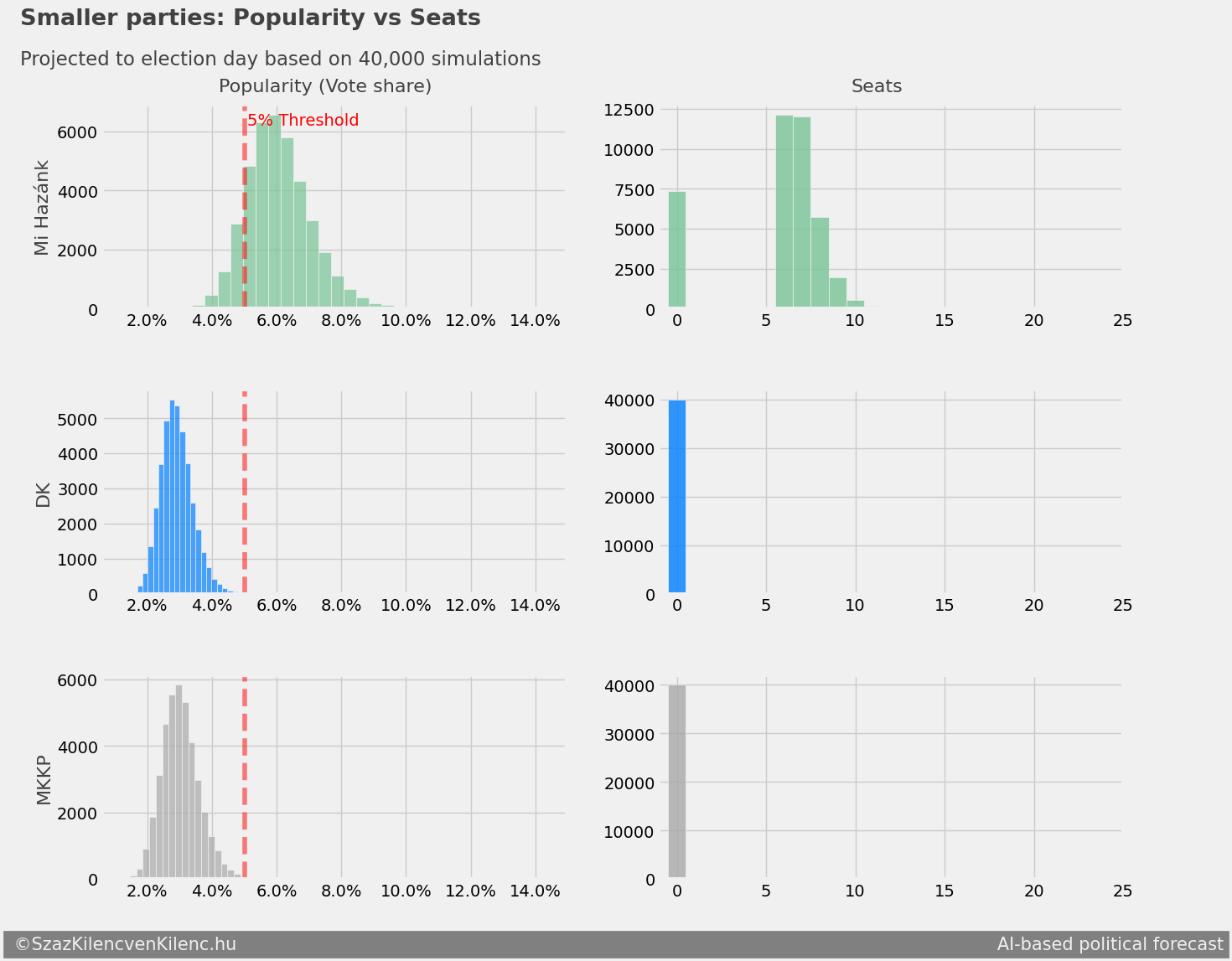
The probability of DK and MKKP entering parliament is effectively zero (0.1% and 0.2%).
Small parties: Mi Hazánk has strengthened further
| Party | Probability of entry | Expected vote share |
|---|---|---|
| Mi Hazánk | 81.6% | 6.1% |
| DK | ~0.1% | 2.9% |
| MKKP | ~0.2% | 3.0% |
Mi Hazánk’s probability of entering parliament has risen from 72.8% on March 8 to 81.6% — the party’s average vote share has also increased from 5.8% to 6.1%. This is the only indicator where a meaningful shift has occurred over the past two weeks. If Mi Hazánk stays out, the lion’s share of seats goes to the two major parties, further improving TISZA’s prospects. If it enters — and that is looking increasingly likely — the three-player parliamentary arithmetic paints a more complicated picture.
What has changed (and what hasn’t) since the previous forecast?
Our March 8 forecast was also built on the Krónikás-v3 model. The most important takeaway from this update: the balance of power between the two major parties is essentially unchanged — the only meaningful shift is Mi Hazánk’s strengthening.
| Indicator | Mar. 8 (v3) | Mar. 21 (v3) | Change |
|---|---|---|---|
| Probability of deadlock | 11.4% | 13.7% | 📈 +2.3pp |
| Probability of TISZA majority | 71.7% | 70.8% | 📉 -0.9pp |
| Probability of Fidesz majority | 16.9% | 15.6% | 📉 -1.3pp |
| Mi Hazánk entry probability | 72.8% | 81.6% | 📈 +8.8pp |
| TISZA vote share (mean) | 46.3% | 46.2% | — |
| Fidesz vote share (mean) | 41.6% | 41.7% | — |
Mi Hazánk’s strengthening slightly reduces both major parties’ chances, but asymmetrically: it increases the probability of a deadlock, which primarily narrows TISZA’s path to an outright majority — not because Fidesz has strengthened, but because seats are now split three ways. The analogy: if you are leading a football match 2-0 in the 70th minute, but a third team has started scoring goals too, the unpredictability of the final result increases — even though you are still firmly in the lead.
Three weeks out: the bottom line
The three numbers that matter most today:
- 70.8% — TISZA’s probability of an outright majority
- 15.6% — Fidesz-KDNP’s probability of an outright majority
- 81.6% — Mi Hazánk’s probability of entering parliament
The picture is stable. TISZA leads, Fidesz stagnates, and Mi Hazánk now stands more firmly above the threshold. The final weeks of the campaign may yet produce a surprise — but for Fidesz-KDNP to retake the lead, the trend of recent months would need to reverse fundamentally. That is not impossible, but according to the model, it is not likely.
A clear winner on election night now seems more likely than not. But Mi Hazánk entering parliament — which is looking increasingly likely — could push the deadlock probability higher still and bring coalition arithmetic back to centre stage.
Important note: Current popularity figures reflect the present situation. Election day results are forecasts calculated from 40,000 Monte Carlo simulations. Actual results may differ from the forecast.
This forecast is based solely on statistical models and does not constitute a political position.
The polling data come from the Vox Populi database, for whose work I hereby express my thanks.