Forecast - 2026.03.08
⚠️ Methodological note: Chronicler-v2 → Chronicler-v3
After publishing the Chronicler-v2 results on Reddit, I received several private messages from researchers and analysts interested in running a similar forecast for their own countries. As a result, I began working on an open-source version of the methodology. To make it work across different contexts, many Hungary-specific solutions were replaced with more general approaches, and certain elements were simplified.
Despite these changes, I believe the simplifications benefit the forecast for the following reasons:
- Lower model complexity, which is justified given the relatively small number of available polls
- Fewer parameters to specify means fewer subjective modelling decisions, reducing the influence of prior assumptions
The current results therefore differ from February for three reasons:
- Methodological changes — though their effect is not dominant
- New polls published since February
- Less time remaining until the election, which inherently narrows the uncertainty
There is barely one month left until the 2026 parliamentary election. According to our latest Krónikás-v3 model, based on 40,000 Monte Carlo simulations, TISZA has built a meaningful lead — and projected to election day, the race no longer looks as open as it did a month ago. The most important development: Mi Hazánk has climbed back toward the parliamentary threshold, fundamentally reshaping the coalition arithmetic.
Current popularity
According to the latest estimate of our Bayesian time-series model, TISZA has continued to widen the gap since February — the difference has now moved beyond what the model’s uncertainty can easily explain.
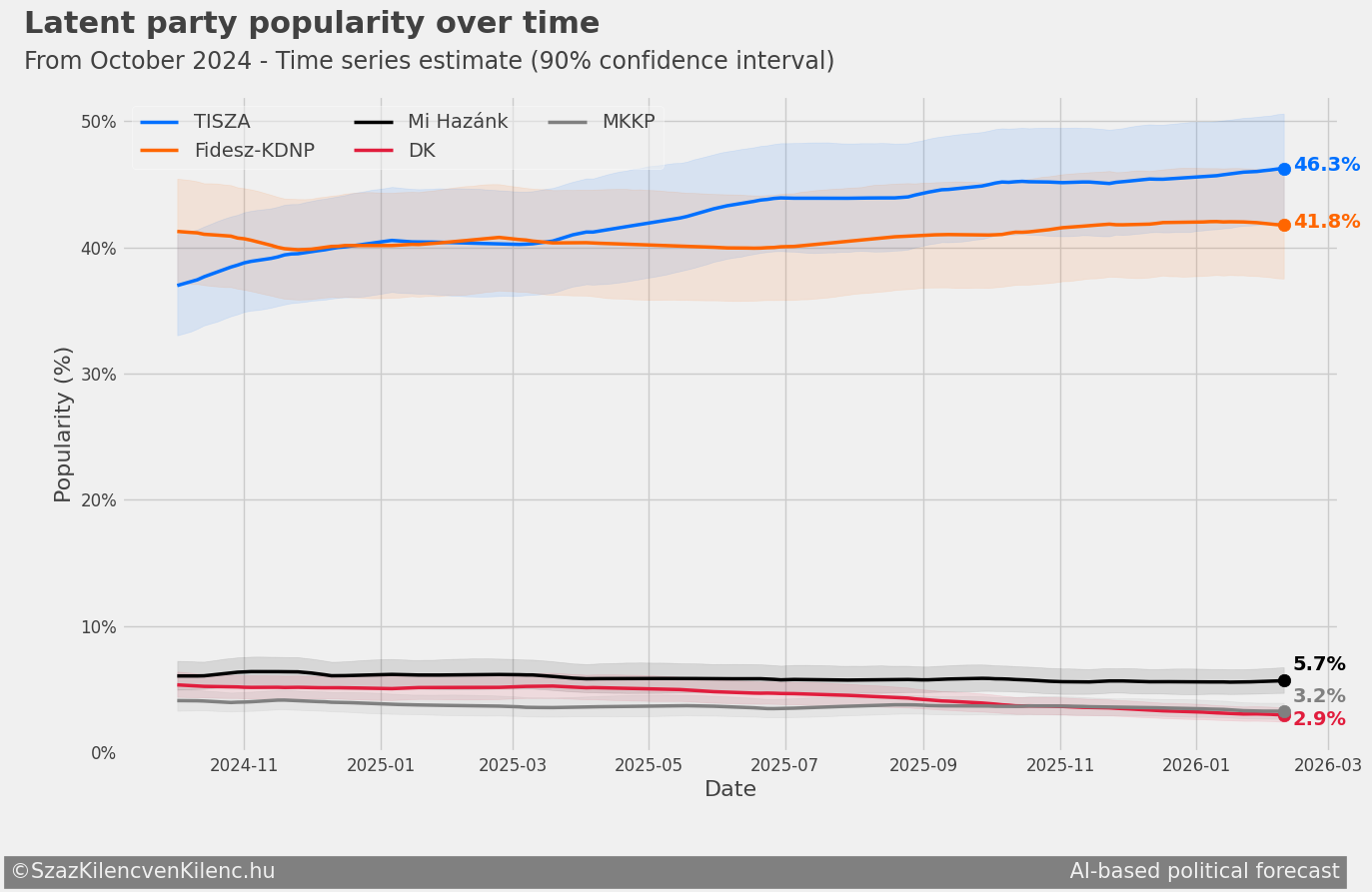
| Party | Popularity |
|---|---|
| TISZA | 46.4% |
| Fidesz-KDNP | 41.7% |
| Mi Hazánk | 5.8% |
| MKKP | 3.1% |
| DK | 2.9% |
| Other | 0.1% |
TISZA leads by 4.7 percentage points. Compared to the 2.2-point gap in February, this is a substantial shift — and the first point in time where the lead can be considered meaningful rather than noise.
Election day forecast: TISZA has strengthened
Vote share
According to our election day forecast, TISZA holds a clear advantage in the majority of simulations:
| Fidesz-KDNP | TISZA | |
|---|---|---|
| Receives the most votes | 23.3% | 76.7% |
| Wins the most seats | 23.0% | 77.0% |
In three out of four simulations, TISZA receives the most votes and seats. This is no longer a coin toss — but the remaining one in four is not negligible either.
Seat distribution
Based on the simulations, TISZA would receive an average of 110.6 seats — well above the 100-seat majority threshold. That said, the width of the distribution remains significant.
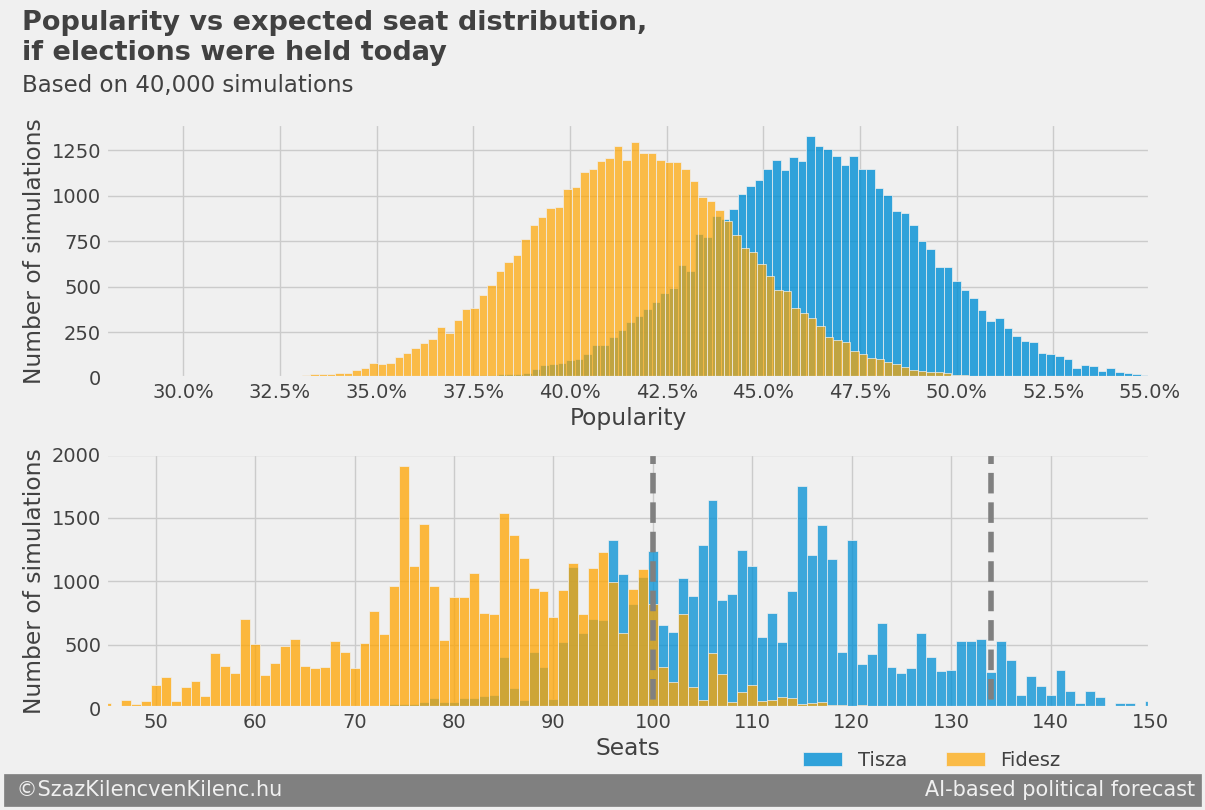
⚠️ Probability of a deadlock: 11.4%
The probability that neither party reaches 100 seats on its own has risen from 4.4% in February to 11.4%.
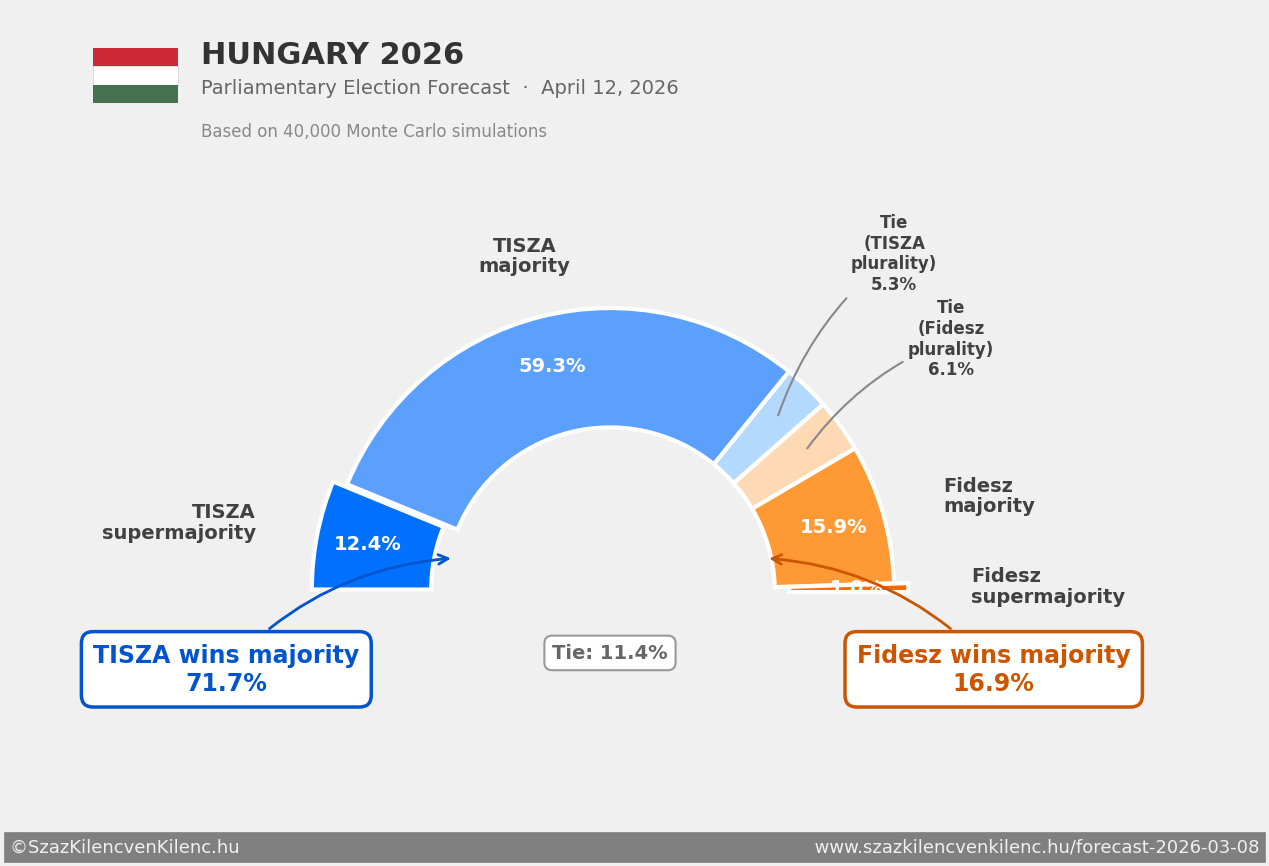
At first glance this seems paradoxical given TISZA’s strengthening — but the explanation lies in Mi Hazánk’s comeback. If László Toroczkai’s party enters parliament, seats are redistributed in a way that increases the chance that neither TISZA nor Fidesz-KDNP reaches the threshold on its own.
| Outcome | Probability |
|---|---|
| TISZA majority (≥100 seats) | 71.7% |
| Fidesz-KDNP majority (≥100 seats) | 16.9% |
| 🔴 DEADLOCK (neither reaches 100) | 11.4% |
| TISZA two-thirds majority | 12.4% |
| Fidesz two-thirds majority | 0.1% |
TISZA holds a clear advantage: it wins an outright majority in nearly three out of four simulations. Fidesz-KDNP’s probability of an independent majority has collapsed from 45% to 16.9% — the single largest shift since the previous forecast. A two-thirds majority is effectively out of reach for Fidesz, while TISZA achieves it in roughly one in eight simulations.
Coalition scenarios
With Mi Hazánk’s comeback, coalition arithmetic becomes relevant again:
| Coalition | Majority (≥100) | Two-thirds (≥133) |
|---|---|---|
| Fidesz-KDNP alone | 16.9% | 0.1% |
| Fidesz + Mi Hazánk | 28.2% | 0.2% |
| TISZA alone | 71.7% | 12.4% |
| TISZA + Mi Hazánk | 83.0% | 17.9% |
A Fidesz + Mi Hazánk coalition now has only a 28.2% chance of securing a majority — a steep drop from the 49.4% recorded in February, driven primarily by TISZA’s strengthening rather than Mi Hazánk’s position.
TISZA + Mi Hazánk is politically unlikely, but mathematically delivers a majority in 83% of simulations — this mainly illustrates that if TISZA falls short of an independent majority, Mi Hazánk could become a decisive factor for either side.
The probability of DK and MKKP entering parliament is effectively zero (0.1% and 0.5%), so those coalition variants add no meaningful value in practice.
Small parties: Mi Hazánk is back
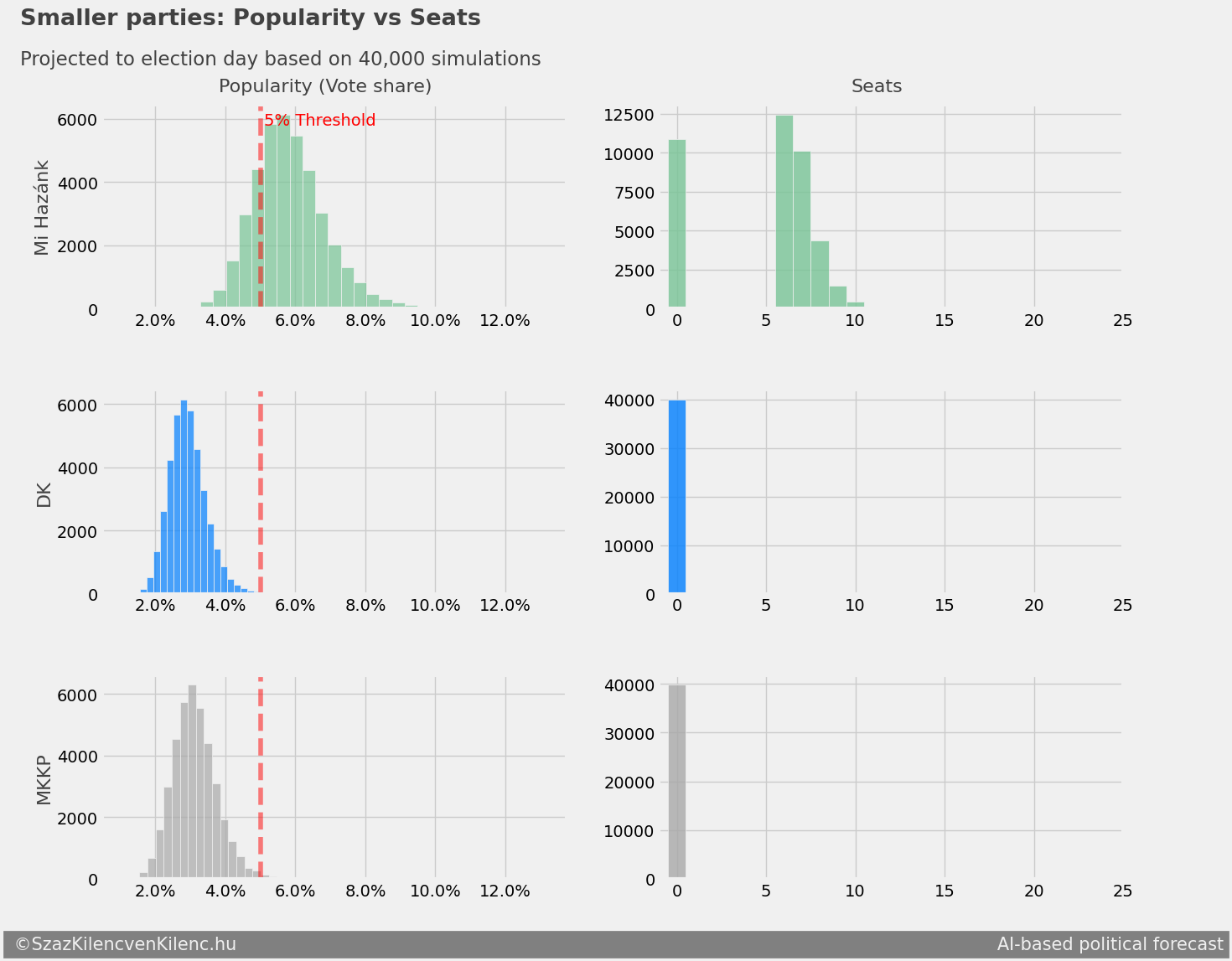
| Party | Probability of entry | Expected vote share |
|---|---|---|
| Mi Hazánk | 72.8% | 5.8% |
| DK | ~0% | 2.9% |
| MKKP | ~0.5% | 3.1% |
Mi Hazánk’s probability of entering parliament has jumped from 26.4% in February to 72.8% — the most dramatic change across all tracked indicators. The party’s expected vote share has also risen from 4.8% to 5.8%, comfortably above the threshold on average, though the spread remains meaningful. If Mi Hazánk stays out, seats are split primarily between TISZA and Fidesz-KDNP — improving the majority picture for both. If it enters, it may play the role of kingmaker.
What has changed since the previous forecast?
Our February 9 forecast was built on the Krónikás-v2 model and February polling data. The current results reflect three combined factors: (1) the model has been updated to Krónikás-v3, (2) new polls have been published, and (3) the time remaining until the election has shortened, which inherently narrows the uncertainty range. The methodological change has a modest effect — the bulk of the movement seen in the numbers is explained by new data and the shrinking time horizon.
| Indicator | Feb. 9 (v2) | Mar. 8 (v3) | Change |
|---|---|---|---|
| Probability of deadlock | 4.4% | 11.4% | 📈 +7.0pp |
| Probability of TISZA majority | 50.6% | 71.7% | 📈 +21.1pp |
| Probability of Fidesz majority | 45.0% | 16.9% | 📉 -28.1pp |
| Mi Hazánk entry probability | 26.4% | 72.8% | 📈 +46.4pp |
| TISZA vote share (mean) | 44.4% | 46.4% | 📈 +2.0pp |
| Fidesz vote share (mean) | 42.2% | 41.7% | 📉 -0.5pp |
The key trend: TISZA has strengthened, Fidesz has stagnated or slightly weakened, and Mi Hazánk has made a dramatic comeback. The rise in the deadlock probability may seem counterintuitive, but Mi Hazánk’s return creates precisely the three-player parliamentary arithmetic that puts both large parties at risk of falling short of 100 seats.
Methodology
The Krónikás-v3 model is built on an open-source, more generalisable architecture. The forecast is based on the following components:
- Bayesian model to aggregate polls, with pollster-specific biases
- Dynamic time-series model to estimate changes in popularity
- Monte Carlo simulation (40,000 runs) to model election outcomes
- Individual constituency models to account for regional effects
Compared to v2, the model complexity has been reduced — a methodologically justified choice given the relatively small number of available Hungarian polls, and one that requires fewer subjective prior specifications. The model accounts for pollsters’ historical performance, campaign effects, and the specific features of the Hungarian electoral system.
Conclusion
The picture of the 2026 election has shifted considerably in one month. TISZA has strengthened, the probability of an independent Fidesz-KDNP majority has collapsed, and Mi Hazánk has climbed back toward the threshold — the last factor being the only one that still introduces meaningful uncertainty.
The three numbers that matter most today: TISZA’s 71.7% majority probability, Fidesz-KDNP’s 16.9%, and Mi Hazánk’s 72.8% probability of entering parliament. If Toroczkai’s party stays out, TISZA’s path to victory becomes even clearer. If it enters, the deadlock probability holds around 11.4% and coalition arithmetic returns to centre stage.
One month out, a clear winner on election night is more likely than not. But Mi Hazánk hovering around the threshold can still upend every scenario.
Important note: Current popularity figures reflect the present situation. Election day results are forecasts calculated from 40,000 Monte Carlo simulations. Actual results may differ from the forecast.
This forecast is based solely on statistical models and does not constitute a political position.
The polling data come from the Vox Populi database, for whose work I hereby express my thanks.