Forecast - 2026.02.09
There are barely two months left until the 2026 parliamentary election. According to our latest Krónikás-v2 model, based on 40,000 Monte Carlo simulations, TISZA leads with a minimal advantage — but projected to election day the race is practically undecided. The key question is not only who will win, but whether anyone will be able to form a government at all.
Current popularity
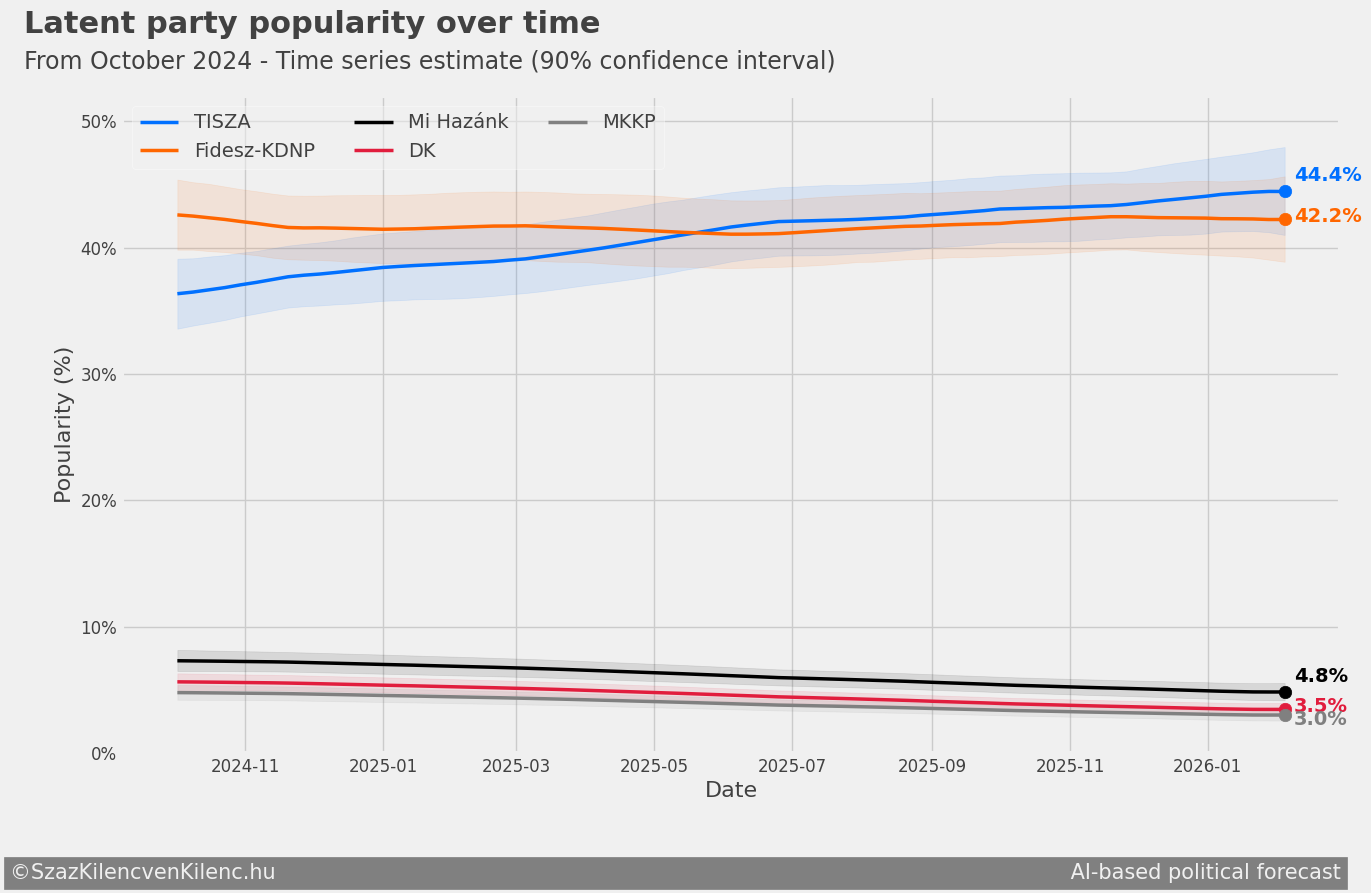
According to the latest estimate of our Bayesian time-series model, TISZA has widened the gap since December (the latest data in the January forecast was from December) — but the difference is still within the margin of error.
| Party | Popularity |
|---|---|
| TISZA | 44.4% |
| Fidesz-KDNP | 42.2% |
| Mi Hazánk | 4.8% |
| DK | 3.5% |
| MKKP | 3.0% |
| Other | 2.0% |
TISZA leads by 2.2 percentage points. Compared to the previous December difference of 0.6 points, this is a meaningful shift — but far from reassuring for either side.
Election day forecast: Everything is open
The two months remaining until the election introduce additional uncertainty into the model. The campaign, polling errors, and last-minute decisions all widen the range of possible outcomes.
Vote share
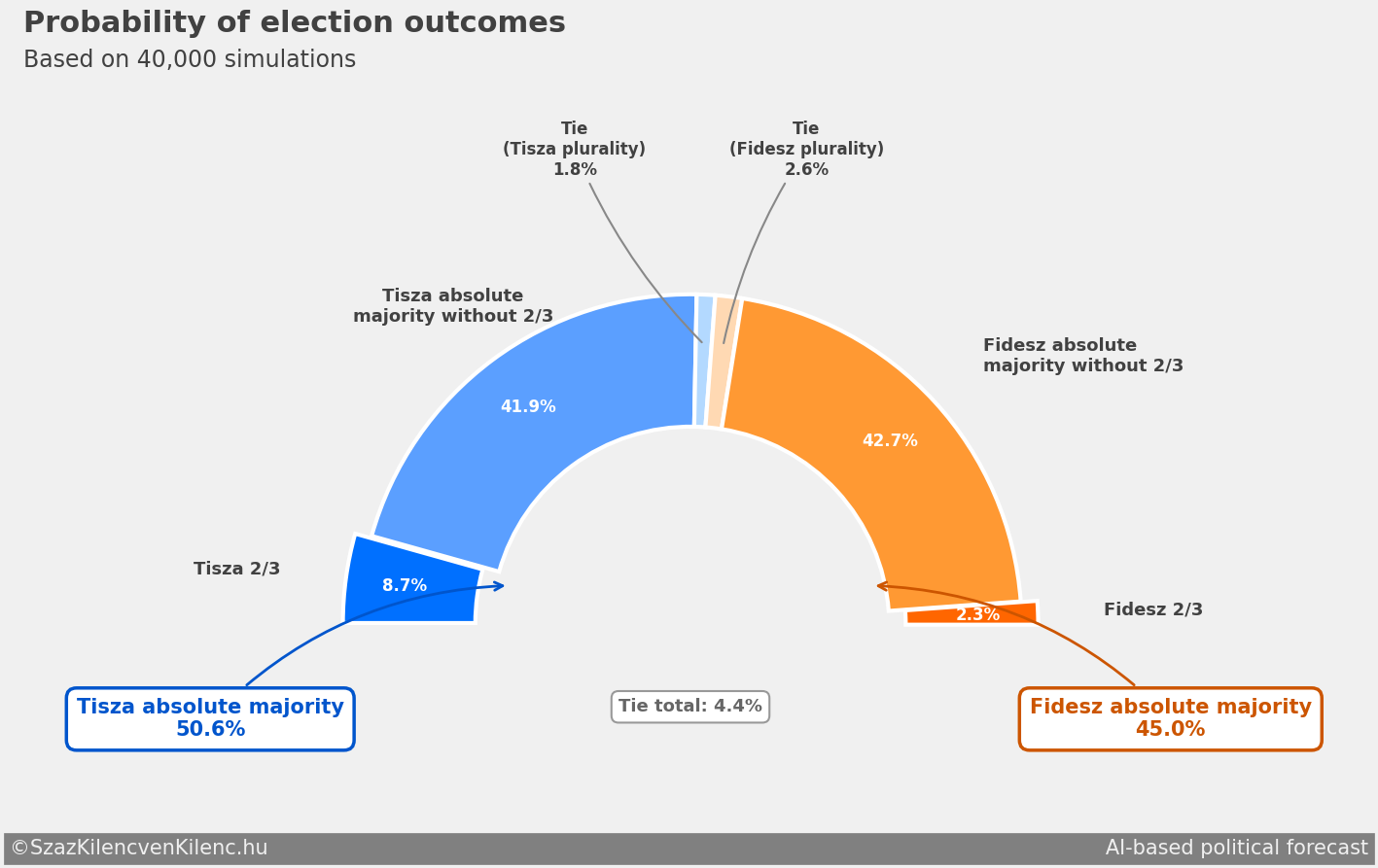
According to our election day forecast, the two parties are essentially tied in the 40,000 simulations:
| Fidesz-KDNP | TISZA | |
|---|---|---|
| Receives the most votes | 47.6% | 52.4% |
In slightly more than half of the simulations, TISZA receives the most votes. This is essentially a coin toss.
Seat distribution
Due to the characteristics of the Hungarian electoral system, the relationship between votes and seats is not linear. The chart below shows that the seat distributions of the two parties completely overlap — on both sides, the outcomes cluster around the 100-seat majority threshold.
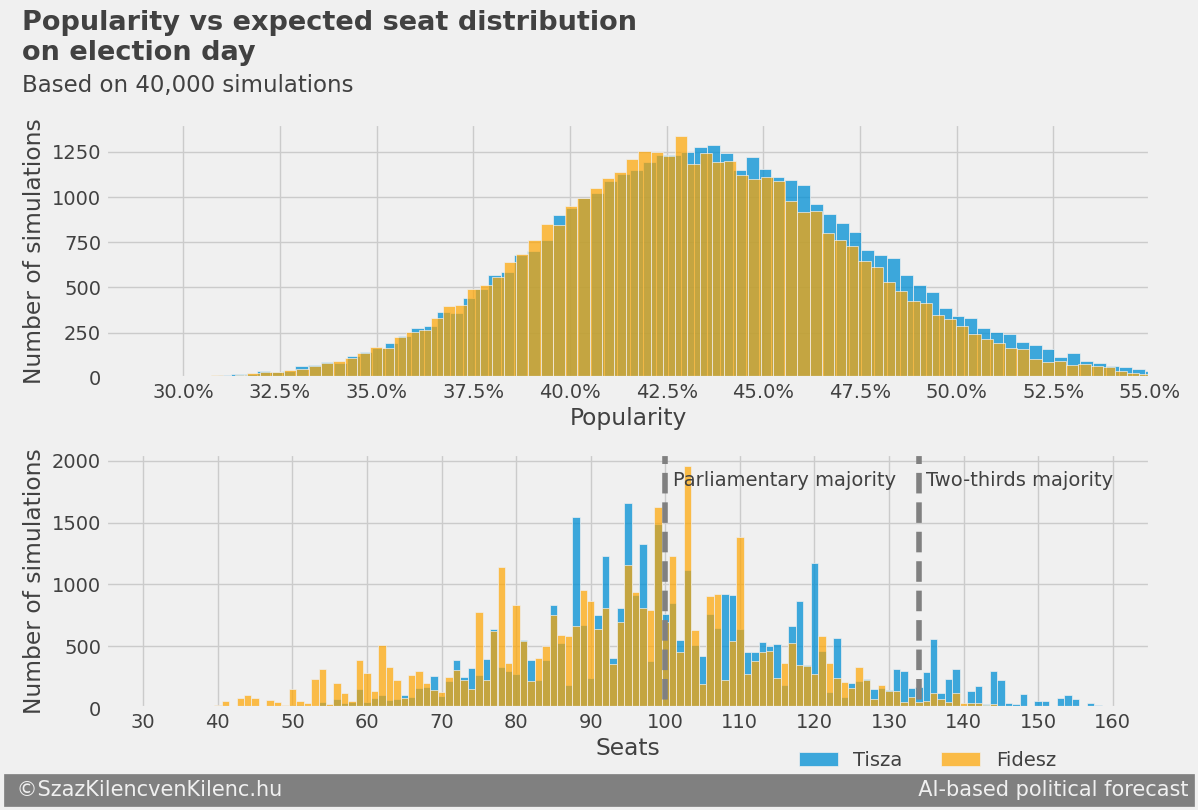
Based on the simulations, TISZA would receive an average of 102 seats — just above the majority threshold. But the width of the distribution is a warning: reality may deviate significantly from this. This uncertainty will decrease as the election approaches.
⚠️ Probability of a deadlock: 4.4%
The probability that neither party reaches 100 seats on its own has decreased from 9.8% in January to 4.4%. This is due to TISZA’s strengthening and Mi Hazánk’s weakening — but a deadlock still cannot be ruled out.
| Outcome | Probability |
|---|---|
| TISZA majority (≥100 seats) | 50.6% |
| Fidesz-KDNP majority (≥100 seats) | 45.0% |
| 🔴DEADLOCK (neither reaches 100) | 4.4% |
| TISZA two-thirds majority | 8.7% |
| Fidesz two-thirds majority | 2.3% |
TISZA’s slight advantage appears here as well: in more than half of the simulations it wins a majority. But the 45% majority probability for Fidesz-KDNP means the final result could go either way. A two-thirds majority is highly unlikely for either side.
Coalition scenarios
If a deadlock occurs — or if either party seeks a coalition partner for stability — the following scenarios may arise:
| Coalition | Majority (≥100) | Two-thirds (≥133) |
|---|---|---|
| Fidesz-KDNP alone | 45.0% | 2.3% |
| Fidesz + Mi Hazánk | 49.4% | 2.8% |
| TISZA alone | 50.6% | 8.7% |
| TISZA + Mi Hazánk | 55.0% | 9.4% |
Mi Hazánk may still play the role of kingmaker. A Fidesz + Mi Hazánk coalition has a 49.4% chance of securing a majority — essentially fifty-fifty. TISZA + Mi Hazánk has a 55% chance. Politically, of course, both scenarios would require significant compromises.
Notably, the probability that DK and MKKP enter parliament is practically zero (0.0%), meaning these coalitions do not add real value for TISZA in practice.
Small parties: Mi Hazánk near the threshold
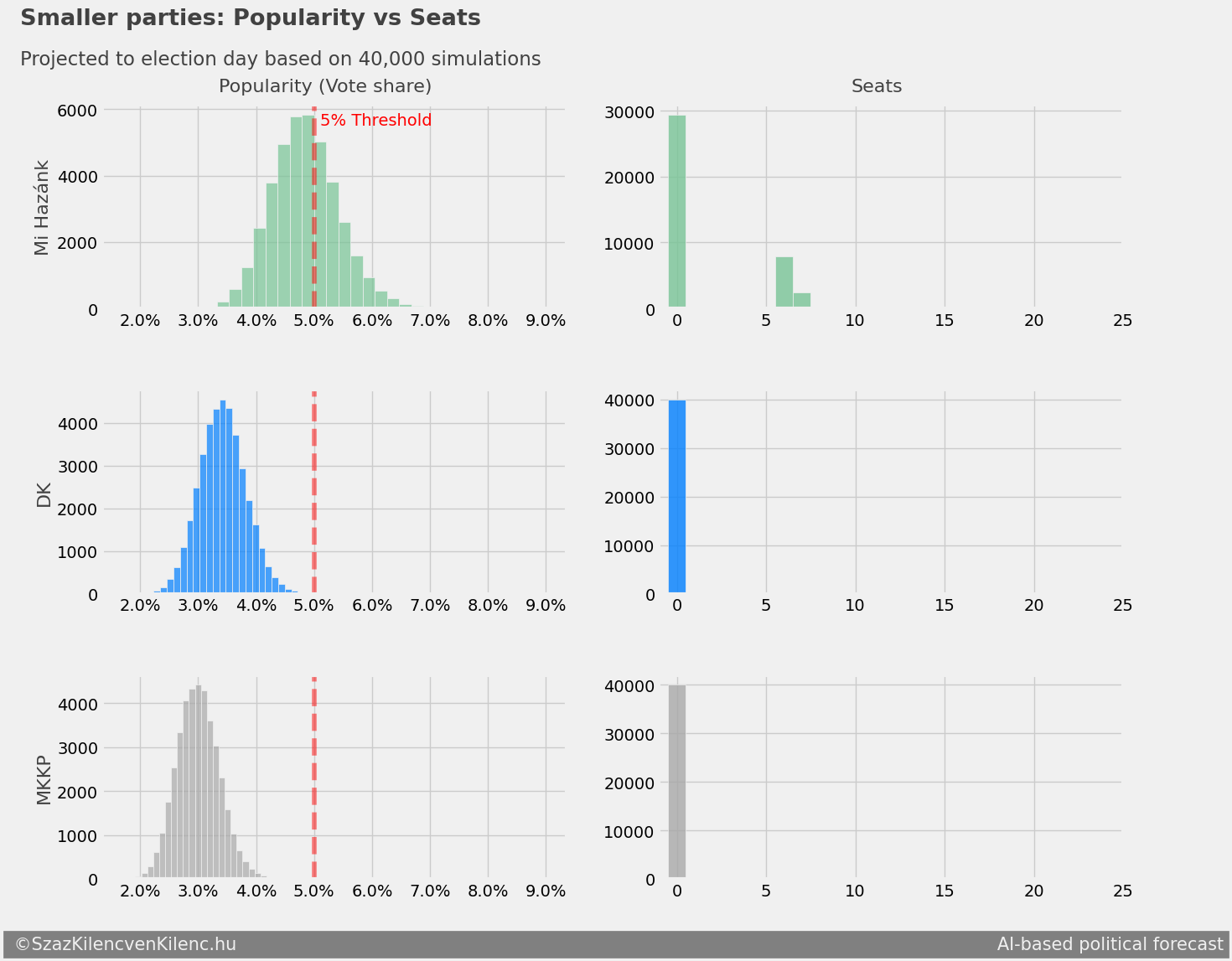
The 5% entry threshold continues to pose a serious obstacle for smaller parties:
| Party | Probability of entry | Expected vote share |
|---|---|---|
| Mi Hazánk | 26.4% | 4.8% |
| DK | ~0% | 3.4% |
| MKKP | ~0% | 3.0% |
Mi Hazánk’s probability of entering parliament has fallen sharply from 52.8% in January to 26.4%. If Mi Hazánk remains outside parliament, it will significantly reshape the seat distribution and eliminate the need for coalition calculations.
What has changed since the previous analysis?
Our previous forecast on January 14 was still largely based on December polling data. Since then, new surveys have been released and the model has been updated. Changes in the election day forecast:
| Indicator | Jan. 14 (Dec. data) | Feb. 8 | Change |
|---|---|---|---|
| Probability of deadlock | 9.8% | 4.4% | 📉 -5.4pp |
| Probability of TISZA majority | 40.3% | 50.6% | 📈 +10.3pp |
| Probability of Fidesz majority | 49.9% | 45.0% | 📉 -4.9pp |
| Mi Hazánk entry probability | 52.8% | 26.4% | 📉 -26.4pp |
The trend is clear: TISZA has strengthened, Fidesz has stagnated, and Mi Hazánk’s position has deteriorated significantly. The probability of a deadlock has also been halved, primarily because TISZA’s January and February polling results were stronger than those in December, increasing the likelihood that votes translate into a majority.
Methodology
Our forecast is based on the following components:
- Hierarchical Bayesian model to aggregate polls, with pollster-specific biases
- Dynamic time-series model to estimate changes in popularity
- Monte Carlo simulation (40,000 runs) to model election outcomes
- Individual constituency models to account for regional effects
The model takes into account pollsters’ past performance, campaign effects, and the specific features of the electoral system.
Conclusion
The 2026 election continues to promise a historically close race. TISZA has gained a slight advantage in recent weeks — winning a majority in more than half of the simulations — but Fidesz-KDNP’s 45% probability speaks for itself: this race is far from decided.
Perhaps the most important figures are not the chances of the two major parties, but the 4.4% probability of a deadlock and Mi Hazánk’s 26.4% probability of entering parliament. If the party of László Toroczkai remains outside parliament, the redistribution of seats could change everything. If it enters, it may play the role of kingmaker.
On election night, it is far from certain that a clear winner will be declared.
Important note: Current popularity figures reflect the present situation. Election day results are forecasts calculated from 40,000 Monte Carlo simulations. Actual results may differ from the forecast.
This forecast is based solely on statistical models and does not constitute a political position.
The polling data come from the Vox Populi database, for whose work I hereby express my thanks.